Analysis: Too Kinky For General Consumption
On usage of the terms "dominant" and "submissive"
There has been a lot of timeline discourse recently (and indeed, for several years now) about male and female desire for sexual power exchange. Particularly in my cross-hairs for criticism on this are redpill influencers and "dating coaches", both male and female.
In my previous post, I attempted to debunk their claim that women exclusively want sexual dominance in a man and are not themselves interested in dominating. This time, I'm tackling the usefulness of the terms "dominance" and "submission" more generally in relation to M/F sexual behaviour.
1. Modalities
What do people mean when they say "dominance" in a partner?
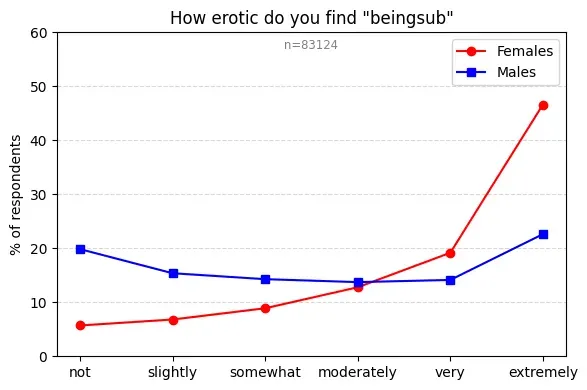
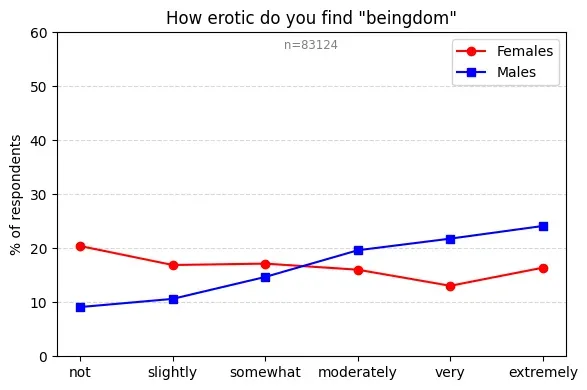
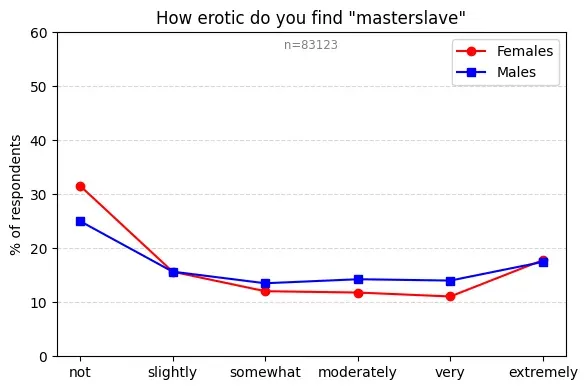
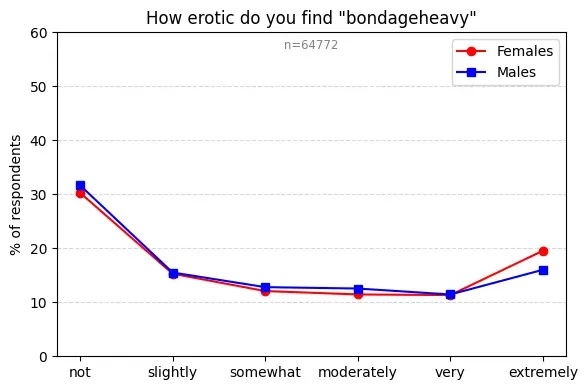
Let's have a look at these four graphs of reported interest in sexual activities. I'm shamelessly stealing data courtesy of Aella again; note that this sample are much younger and kinkier than average:
Let's note the graph shapes first.
For women:
- The graph for "beingsub" is parabolic; J-shaped with a clear increasing preference all the way up to the maximum.
- "Beingdom" is more-or-less flat.
- "Master/slave" is bimodal; female respondents tended to react very negatively, with a small second peak at "extremely erotic".
- "Heavybondage" is bimodal with the negative peak much higher.
For men:
- "Beingsub" is flat or lightly bimodal.
- "Beingdom" shows gentle linear slope to the positive side, but no exponential.
- "Master/slave" is bimodal with the negative peak higher.
- "Heavybondage" is bimodal with the negative peak much higher.
The clear outlier in these graphs is "beingsub". In all the other graphs, male and female interests track quite closely to each other. But on "beingsub", female interest skyrockets while male interest retains the rather tame, flat trend it shows almost everywhere.
A couple of questions arise from this.
- Why do BDSM acts show bimodality while the other graphs show trends?
- Why are men and women broadly aligned on their attraction to BDSM acts, but highly divergent on their preference for dominance and submission?
On the question of bimodal distribution, Aella explains it via a theory of "bdsmexuality" – an innate attraction to power dynamics. Those who have it cluster to the positive end of these spectra; those who don't (the "tendersexuals") have their highest concentration at the "not erotic" end. I believe she's basically correct on this point and don't want to re-cover the contents of her article.
I don't believe she covered the other question, so I'll keep my focus there.
We know from the femdom ratio meta-analysis that maledom and femdom preference are virtually mirror-images of each other, with a ratio of around 1.5-2:1 in favour of preferring submission in each pairing, but that male dominance is overall more prevalent. So in theory, the "beingdom" and "beingsub" graphs should show basically the same shape for each gender, but with reversed gender ratios. I don't believe any of the studies in that previous analysis would support an extremely prominent J-curve for female submission, with only flat or gentle slopes for all other scenarios. And especially given that the data showed preference for BDSM acts is usually higher than BDSM role ID – but here, we see the opposite case, of the generalised sexual submissive role being rated far more arousing than any individual act or type of play.
My strong intuition, having spent much time puzzling and reading almost every blog or personal opinion I can find on the topic, is that women more frequently use the terms "dominant" and "submissive" as substitutes for "active" and "passive". When many women say they want a "dominant" partner, they mean they want a partner who is competent, passionate, and crucially, one who initiates.
Men, on the other hand, understand the terms more straightforwardly in the sense closest to BDSM. I believe the reason for this is that the BDSM concept of "dominant" and "submissive" has its origin not in heterosexual relations but in male hierarchy and homosocial intercourse (this will be the subject of a later blogpost).
This misunderstanding has been something of a tragedy for young people discovering their sexuality through anonymous social media.
"Women want to be submissive!" cry male dating influencers.
"Well yes, but… [insert sensible clarifying factors]," reply women.
"OK, let's ignore the nuance, that means to attract women I have to choke them out," thinks the impressionable young man.
"My boyfriend is trying to choke me, this must be what men want from me," thinks the fretful young woman.
Result: resentment on all sides; deterioration of gender relations.
In fact, as I observed in my meta-analysis of the femdom ratio, the picture is much less clear-cut; though sadomasochistic impulses exist at a fairly high prevalence in the general population, the desire is not unidirectional (with an especially high proportion of versatile "switches") nor is it anything like universal.
The terms "dominant" and "submissive" are simply too kinky for these purposes, and they allow a kind of motte-and-bailey whereby the claim "all women want to be sexually dominated" can be made (and an image of "Morning Glory Milking Farm" cued up), and then when the dissenting voices begin, a more vanilla understanding of "dominance" (initiation/passion/topping) is then adopted. A clearer distinction between "dominance/submission" and "BDSM" would go a very long way towards restoring balance here.
2. Polarities
From now on, I won't use the "dominant/submissive" framing for anything except strict BDSM, for the sake of clarity. The vast majority of BDSM fantasy and activity falls somewhere on the sadomasochistic spectrum, so wherever possible, I will replace it with Sadistic/Masochistic.
In other contexts, I believe the following axes are generally more appropriate for analysis:
Active/Passive – referring to who takes sexual initiative. Note that one can easily be a "service top" who "leads the dance" purely for the pleasure of a passive but psychologically dominant partner.
Top/Bottom – The act of penetration is not inherently dominant; being penetrated is not inherently submissive. We need a way to talk about this dynamic without resorting to the same tired tropes of power exchange. Thankfully, the gay community invented this very helpful terminology way in advance!
I want to explore other heterosexual polarities and cultural archetypes in a later post – ones that respect the very real preference in both sexes for an initiating male, but don't fall back on the reductive framing of "men are naturally dominant, women are naturally submissive".
A few for brief consideration:
- Artist ↔ Muse
- Knight ↔ Lady
- Sailor ↔ Siren
Stay tuned!